|
THE ESSENTIALS OF
FINE AUDIO RECORDING
WHY AND WHEN YOU NEED A RECORDING PROFESSIONAL By Drew Daniels OPINIONS, OPINIONS;
EVERYONE'S AN AUDIO EXPERT — AND KNOWS THEIR OWN JOB TOO!
The whole point of today's recording "problem" is that anyone can buy ProTools™ and some recording gear for a few hundred bucks from just about any music store, but no matter how hard the cynical audio magazines pitch expertise from a box, neither technical nor musical experience can be put in a box and sold to consumers. Writing about the way things sound is much like writing a food magazine. Readers must taste the recipe to test it. So it is with sound. Sound must be heard to experience it in any meaningful way. My bookshelves are filled with big, thick 600-page manuals on topics like ProTools, Final Cut Pro HD, DVD Studio Pro, and then of course, dozens of textbooks on audio, acoustics and recording. How many people who purchase Cubase or Logic or Digital Performer or ProTools, actually open the box and read and digest a 600 page manual before they declare they are ready to record and charge clients money for their time? How many of these same people really know Rock, Jazz, Cajun, Funk, Classical, Pop, Choral, Symphonic, Chamber Music, Bluegrass, Americana Roots, Blues, Opera and so on, to the degree that they can automatically spot obvious edit points in the musical product, or know what might require attention for mixing details to create a musical recorded product that sounds the way it should sound to fans of the genre, and more importantly, to the client? I can tell you this: Most of the clowns who say they're experts with their ProTools are slobs who can't read, never annotate their tracks with meaningful names, or make notes that another studio can use to figure out the mess they've left on their clients' portable hard drives. In late '08 a jazz singer brought in a portable hard drive with a "simple" acoustic jazz piano, bass, drums, vocal session done in an expensive studio in Burbank California not too far from here. I won't assume you know all about "typical" jazz trio and vocal recordings, but suffice to say the goal is usually a natural acoustic sound that generally means the drums are miked with a pair of overheads or a single stereo mike, and a supporting mike on the foot drum. The piano is miked in stereo and sometimes the bass is miked stereo, but more often one mike, and the vocalist on one mike. This moron had 11 drum tracks in the ProTools session and they were all turned on and active when I pushed "play" (they also sounded really bad, like trashcans and cardboard boxes, and nothing at all like jazz drums). The singer wanted to make a simple copy of her mixes without the vocal so that she could use the CD of her own album as a "karaoke" to sing for an elderly lady's birthday that weekend. Simple, right? Shut off the vocal, tell ProTools to make a mixdown, cut it up and transfer to a CD. A no-brainer for any beginning recording student. But somehow, the moron engineer with 11 drum mikes had managed to mute all the other tracks in a cleverly hidden way that I could not discover in 45 minutes of tinkering or before the singer had lost all faith in my abilities and 48 years of pro recording experience, or the fact that I make dozens of CDs every year and win Record Of The Year awards and Grammy nominations for best sound. Though the waveforms on the screen clearly showed the voice, piano, and bass, nothing I could do would turn those tracks on, or solo them. I could mute or solo the drum tracks OK, but the piano, bass and vocal were simply inaccessible. First, this is unforgivable malpractice on the part of the Burbank recordist, second, it is criminally incompetent programming on the part of ProTools that could result in a situation where there is no way to hear what is right there on the screen in front of you. I told the singer I was sorry to waste her time and would not charge her, but that she was stuck with the expensive studio in Burbank to figure it out. I do not know if she had music for her birthday party for which she would not be paid, but I kind of doubt it owing to the high rates at that Burbank joke. There are probably on the order of half a million folks in the U.S. alone who call themselves "recording engineers," but far fewer than 1 in 100 of today's so-called "recording engineers" are real engineers at all. They operate recording equipment, but don't know the wave length of C-6 or the difference between vector and scalar sound, or even the key-signature of A-minor. If you're curious about engineering, try the Recording Studio Employment Quiz to see what you remember on basic audio engineering questions. It's often said "if it were easy, everyone would do it," and that's exactly why bottom line-oriented manufacturers pump out hardware and software in a greedy and misguided attempt to make everyone an instant expert, saying "we're 'empowering' musicians." To some degree this marketing strategy works, and tens of thousands of musicians now record their own music and operate home studios. As an unintended consequence (isn't it sad how many times that word "unintended" ends up being used to explain an awful lot of consequences?), this drags down the public perception of the value of real engineering and experience—and here's a coincidence—just like the junk recordings and CDs flooding the market ever since recording was made available to everyone, trashing the value and perception of music in general and damaging the earning potential of good artists right along with the wannabees cranking out garbage. Desktop recording in the hands of Americans in particular, who are less apt to read a manual than they are to read their insurance policies, produces sound that ranges from very good to very bad, but also—and here is the biggest part of the problem—SO MANY recordists from which to choose, to try to find one that's closer to the "very good" side of the lot than to the "very bad" side, and of course, all folks who possess the same basic human resistance to accurate self-assessment. Self-assessment study: LINK The goal of any music project that aims to entertain is to make music that engages the listener or to put engaging lyrics sung with interpretation into a framework of music that supports their 'theater' and tells the story so that the audience successfully receives the communication from the artist. The task of audio production and engineering is to support that communication and at the very least do no harm to it, but if possible and most importantly when appropriate, enrich and magnify the artistic message. 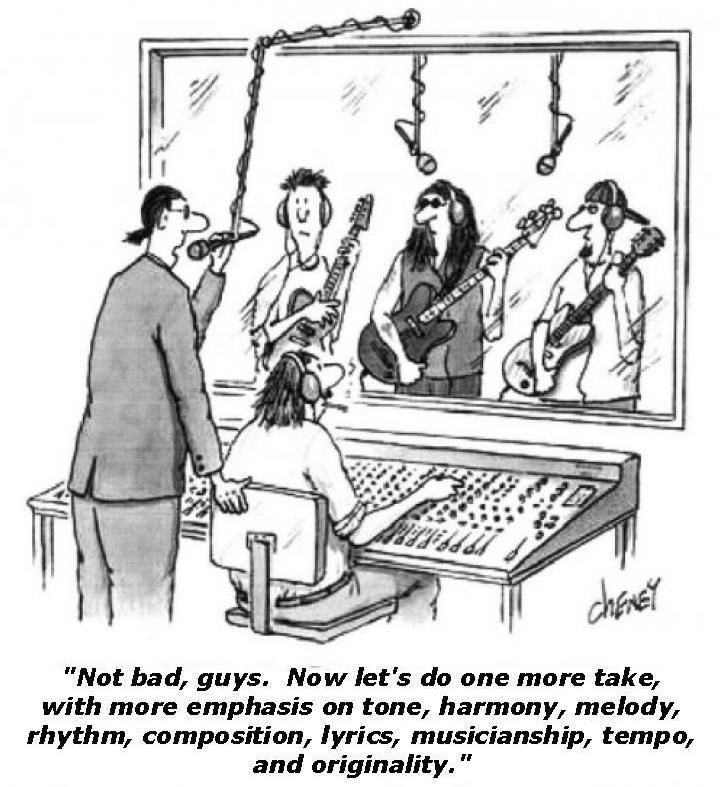 The other side of the same coin is this: No amount of electronics or wizardry in a box, can give a recording engineer musical ability or understanding, just as no amount of money spent on musical instruments or university degrees in musical composition, can give a musician an intimate knowledge of acoustical physics or the electrical characteristics of microphones and loudspeakers. Studio real estate and racks of expensive electronics have no skill at making music. To believe they matter musically is exactly the same kind of path to disappointment, as believing that driving drunk in a Ferrari is safer than driving drunk in a Camry. As a result of the explosion of home recording, there are a hundred or more, big, expensively built and furnished studios in the Los Angeles area alone—those that haven't already been closed—where you can buy ProTools HD™ recording time at $20 an hour—without an engineer of course. Usually your $20/hr rate gets you a “second” engineer, that is, an intern who (sometimes) knows what's connected to the patch bay in the control room. The intern may or may not know anything about microphones and musical instruments, different genres or styles of music, or how to interface the enormous complexity of the recording studio to your artistic intentions. As a recording artist, even if you already record at home with pretty good results and great enthusiasm, you may be placing yourself at some risk musically. You're almost certainly not getting everything the technical complexities of your recording equipment can provide. This is where the help of a professional can make the difference between just a good home-produced CD, and a world-class or exceptional CD. Most older and experienced recording artists already know this. Some build home studios and hire professional engineers on staff. Others use project studios like Sound Path Labs to get Grammy nominated sound*1 on a budget. Let's face it, self-produced CDs are risky business unless one of your parents heads a major record label. Like the man said "the surest way to come home from Las Vegas with a small fortune is to go to Las Vegas with a big fortune." It makes the most sense to get the ultimate vibe for artistry at the same time you get the best efficiency your budget can accommodate—a highly skilled, musical, and sympathetic recording professional. You shouldn't have to try to play your instrument while you push faders and buttons and try to remember how the fourteenth file for the guitar punch-in was labeled on the computer. Unburdening yourself of those tasks so you can focus on music, can have an enormous effect on the musical and sonic outcome of your project and will most certainly make the efforts in the studio flow instead of hop or stumble along. OPINIONS... • It's very
helpful to be a trained musician—preferably at the professional level
with college studies in music—to be a truly excellent recording
engineer, particularly when dealing with anything beyond the simplest
forms of music, or to put it bluntly, music that has any subtlety at
all. To have the necessary objectivity to function nominally or
better as a
recording engineer, it's also imperative that live music listening be
part of the balanced diet of artistic and technical nourishment that
builds
the engineer.
• I am of the
opinion that equipment used to record the art should be as transparent
to that art as possible, and at least up to the task. In a nutshell, the gear means nothing; the
talent means everything. Gear is only really important if
it
gets in the way of simply capturing what goes on in the studio or on
stage, or if it is technically flawed enough so that it exhibits
performance noticeably inferior to its competition. Once the
music is safely captured, a copy of it can be tweaked or twisted a
little or a lot, but nothing can be done to sounds that escape or to
sounds that are folded, spindled or mutilated before they are safely
stored. In my entire career in recording, the only times I have
ever even discussed gear with clients was when those clients were
amateurs or lacked musical chops or self confidence. The pros
generally leave the techie stuff to a pro
that they can trust to decide on equipment issues.
• I am of the
opinion that a lot of the so-called MASTERING
done today should be regarded by the U.S. legal system as
a criminal offense. There is an admirable 100 year history of
electrical audio engineering that has always striven to get the best
quality audio possible and which has always taught that clipping is
to be avoided at
any
cost. Engineers who
knowingly push digital audio systems past clipping should be
blacklisted and not permitted to victimize artists or music lovers.
In just the past few years the "LOUDNESS WAR" --the insanity of the escalating competitive push for loudness, has ruined many fine musical documents and robbed the listening public of the opportunity to hear what the artists intended musically. One glaring recent example is the Grammy winning Best Contemporary Blues Album of 2001, which was, again in my opinion, murdered by over processing. Modern recording equipment is easily capable out of the box, of making recordings with total harmonic distortion levels as low as 0.001% or lower, in other words, distortion products 60 decibels below the level of the signals that produced them. The Delbert McClinton CD has 40% harmonic distortion components added in by the massive over processing, to make the music sound bright and loud, however on a set of flat, wide bandwidth studio monitors or a good hi-fi system, the CD is so bright and more importantly, so gritty and edgy—like tearing paper—that it is unlistenable at anything over whisper volume levels. An example of gratuitous over processing that is glaringly obvious is Alison Krauss' vocal recording on "Appalachian Journey" and "Classic Yo-Yo" where the sound of the string instruments which cannot be processed without obvious obnoxious consequences, stands in stark contrast to the vocal that someone thought could suffer such trashing without anyone noticing. Well . . . maybe in a convertible . . . at 90 . . . after the fifth beer . . . . Even given the benefit of doubt, 40% harmonic distortion is at least four million times the amount of distortion made by recording equipment. What a terrible shame that such great musical documents have shit smeared all over them. Criminal, because we will never know what Mr. McClinton or Ms. Krauss did in the studio or what they intended their performance to convey to their faithful audience. Musical heritage lost to stupidity. In my opinion, there simply is no excuse for this kind of desecration of recorded music. And here's the irony of this abuse: mis-mastering is done TO MAKE SURE THE CD WILL BE LOUD ON THE RADIO, when in fact, all radio stations ARE GOING TO COMPRESS IT WITH THEIR OWN MULTIBAND COMPRESSORS so that their radio station sounds loud to station-surfers in cars. The mastering facilities didn't have to ruin the product in the first place, because the radio stations were going to do it later anyway! 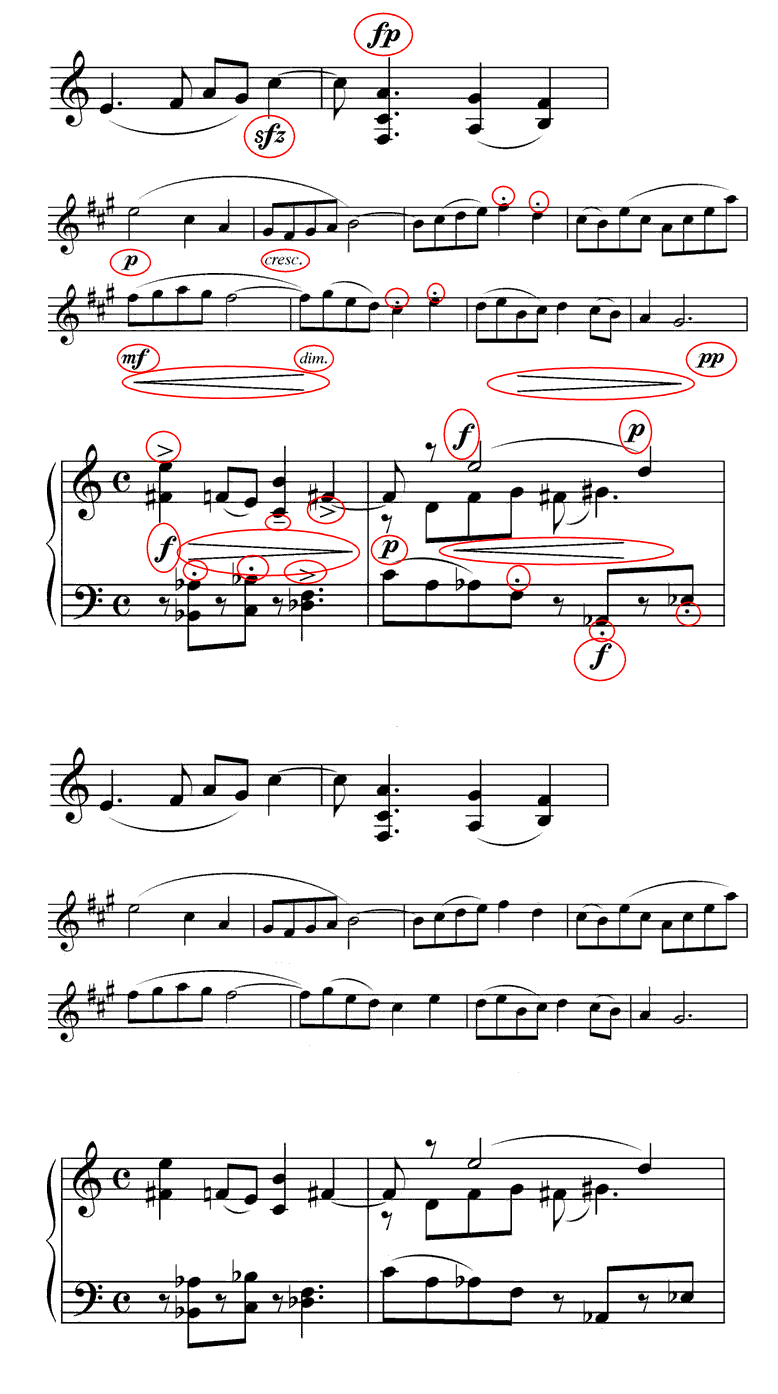 This is what happens to
music when amateurs and professionals alike, misuse compressors.
Those markings circled in red are DYNAMIC MARKINGS. They
are PART OF THE
MUSIC. Their meaning, if not the result of their playing, is
stripped away and trashed by compressors. Even the most "benign"
use of a compressor changes what the composer, conductor, drummer,
guitarist or singer intended
for the listener to hear as the story to be told—the theater—from
the music on the recording. If compressors do that much damage,
imagine what all the other trash boxes destroy, particularly the Aphex
Dominator, which loudens recordings by actually clipping off waveforms
and adding massive amounts of harmonic and inharmonic distortion (crap
that wasn't there in the studio recording) to the sound.
RECORDING EQUIPMENT ENVY Most outrageously expensive consoles and pieces of outboard gear are purchased to impress clients by staying current with audio magazine buzz. Sometimes they may increase production speed, but more often they slow things down. Most often, the buyers of the gear are not the operators of it. Superstitious or insecure clients with heads full of buzz words rather than facts, care far too much about audio gear and far too little about the recording engineer's skill. In over 40 years of recording clients, I can't actually remember discussing equipment with anyone who was a decent musician. When the studio hands the client the finished master or CD, all that really matters is listeners' emotional response to the recording. The public almost never hears or reads about the recording equipment, and couldn't care less. Most people at the movies get up and leave when the credits start, and most people never read the CD booklet either. I have occasionally detailed the gear and the processing for audiophile market recordings because sometimes audio purists like to read about how little was done in the recording process to deteriorate the music, but in the history since hi-fi began, I can only recall a few dozen records that offered this kind of information. It is rare indeed that a record reviewer ever mentions the sound of the record, unless it's really bad. If it's good, it is simply assumed to enhance the musical message contained in the tracks. Reviews LINK HISTORY Recording engineering is a discipline that came about in order to capture ambient art or transient performance. Just like photography, nice photographs can be made using very inexpensive cameras. Certainly photos with plenty of emotional impact can be made with cheap cameras, but are more likely either an accident or the result of the skill of a superior photographer. Still, Ansel Adam's contact printed box camera negatives simply contain more information and more accuracy than one can obtain with a 35 mm camera, and that is the state of the recording equipment art today—nearly every recording system for sale at the local music store is of sufficient quality to allow for what a master recording engineer can do with skill and microphones. Just remember that buying an 8x10 box camera doesn't make the owner Ansel Adams. When Larry Phillips, Bill Caulfield and Dick Rosmini created Tascam and created the home recording hardware and marketing that started the personal recording revolution around 30 years ago, the quality of the gear was itself “semi-professional” even though some skilled recordists with a lot of careful tweaking and coaxing, were able to produce master quality tapes. [13 MB mp3 of 1983 track produced on my Tascam 8-track] Now three decades later, the same quality shortcomings are no longer an issue. Today, even the least expensive digital recording equipment is usually capable of producing recorded material at or near the state of the art in the recording industry. It's as if everyone who records at home on their computer had the big box camera. Now it comes down to what to do with the equipment and how to put together a finished construct with the recorded tracks of sound created in the studio. I firmly believe that excellent recording engineers, in addition to having professional music chops, must have at least a solid working understanding of the physics of sound and the equipment used to capture, manipulate and reproduce sound, as well as the physical—including acoustical—characteristics of musical instruments, and of course the acoustics of materials, spaces and rooms, and a deep understanding of the human hearing system discussed very briefly at the end of this page. Knowing the word “cardioid” but not what it means, does not make one an expert on microphones. A microphone expert can repair them, and ultimately design their own microphone. To know what a loudspeaker is and how it works, one must take paper and pencil and design one, the coil and magnet, the steel, the paper, the box, the crossover, the horn and so on. One must be dedicated and read like a maniac to learn the huge amount required by these subjects. There's more to learn in audio than there is in law, and just look at the enormous number of books law students must read. Let us not worry for now of sound waves, propagation, dispersion, diffraction, absorption, diffusion, vectors and scalars, air particle velocity and all that scientific stuff that real recording engineers know. After all, that is what musicians should be spending thier money to avoid so that an actual engineer will deal successfully with those phenomena and make them work for the music. EXPERTS FRESH FROM RECORDING SCHOOLS In some countries, when the recording engineer graduates from university, he or she receives a Master of Arts degree in music and a Master of Science degree in electrical engineering. These folks are then known as “Tonmeister” and are theoretically at least, equally at home scoring a symphony, or designing DSP algorithms for convolving reverberation cues taken from in situ measurements of multidimensional acoustic transfer functions of music performance spaces. Recording schools that promise expertise in a few months, for the most part churn out fader-pushers who, if they are lucky, might find work doing live sound in rock clubs for ten bucks an hour or maybe sweeping floors in a $500 an hour scoring stage. But to even the most casual observer it should be intuitively and abundantly obvious that all the knob twister mills that victimize so many wannabees cannot impart the necessary experience of years or decades of practice and discovery. Only years or decades of practice and discovery can do that. This last point argues persuasively I believe, that musical artists should seek out and utilize experienced engineers whenever possible, but especially when sound quality and fidelity to their artistic intentions, is important. And when is it not? Well, certainly for anything more than the most basic songwriter demo, or any time you've poured your heart and soul into what should rightfully become an enduring musical document and a statement that says what you meant to say. As I stated earlier, recording gear means nothing and talent means everything. Technically, I believe that it's correct and proper to use equipment necessary to do the job at hand. If the job at hand is to crank out TV shows on a daily basis against airtime deadlines, or to manipulate hundreds of audio tracks for a major movie release already a month behind schedule, then by all means, you need a million dollar SSL with seating for five mixers. If you have a home studio that records from one track at a time to the occasional live-in-studio band, then even thinking about an SSL console is pure silliness. In a home studio like mine, open to clients, not only would a giant console slow me down, but it would cost more than my mortgage and force me to quadruple my rates just to open the door and pay the power bill. My air conditioning bill is already $1000 during the summers here in Los Angeles, but with a big console, it would be two grand, plus thousands of dollars a month for the console lease. See where this goes? I strongly believe that if you're getting good results with the gear you already have, the only reason to purchase more gear is to make an audible improvement. Never spend money on electronic equipment that can't convincingly demonstrate some desirable audio trait or effect or an obvious improvement in your product. As an example, because I have a close relationship with the audio industry that I worked in for years, I'm sometimes able to audition new products. Some such products I've demo’d here are high end microphone pre amps. Without telling my clients at the time, I substituted several different $3000+ microphone pre amps to do certain drum, acoustic guitar, and vocal tracks. My purchasing decision was easily made for me when none of the clients noticed any difference between fifty grand worth of microphone pre amps and my $1000 mixer. No-brainer. I felt as if I had saved $50,000. In 2003 I encountered my first client who insisted that his CD master be made to sound loud so as to “compete” with CDs in the "radio marketplace." This is usually the domain of metal rock CDs that are mastered using compressors that often clip the audio and add distortion to the original clean sound. Such mastering technique is to me, obnoxious, and renders the victim CDs unlistenable on decent audio playback systems and hi-fi systems. Such is the case of the 2001 Grammy winner, Delbert McClinton. The music is swell, but the sound is awful—ruined by hopelessly over processing and using destructive gear that removes any possible way to hear how the recording sounded when McClinton recorded it. In my case, I opted to purchase a fast VCA-based compressor/limiter that effectively but politely squeezes dynamic range. Fairly large amounts of compression can be done with reasonably little audibility. With the combination of this analog tool and the “look-ahead” digital limiting and compressing in my DAW software, I can (if convinced of the need), make CDs sound loud without totally ruining the music or the listener experience. Though I'm philosophically opposed to “altering” the dynamics of recordings, or at least keeping compression to an inaudible minimum, clients will occasionally have something else in mind, and that's what helped form this purchasing decision. A clear case of having the tools for the job, just as anyone skilled in a craft would approach any new challenge. I always keep in mind the old adage that “if all you have in your toolbox is a hammer, then every problem begins to look like a nail.” It's also worth mentioning that as of now (September 2009) I have used the new $1000 compressor exactly once, though I have mastered several hundred CDs since that one insistent client. All this audio “philosophy” is at best a lot to digest, and at worst a dogmatic lecture, but ultimately, “The proof of the pudding is in the eating.”2 I invite any artist serious about their craft to visit me as a potential service provider who is serious about my craft and diligent about yours. Some listening from our past recordings and some discussion about your project will put everything into perspective and provide a path forward either with Sound Path Labs or another recording studio. There are a few things I will not do because they bother my conscience. I won't steal music, no matter how little, from copyrighted recordings to make a background for someone to talk over. I won't crush a nice musical piece of craft so that it sounds bad just to make it loud. I won't cut part of a verse or chorus of a song because some musically impaired marketing executive thinks it's cool (just use a shorter portion of the damn clip, you idiots!). I find these things deeply offensive, and on more than one occasion have turned away this kind of job. Yes, even audio engineers can have a conscience. -Drew Daniels SOME TECHNICAL BACKGROUND ON THE DIGITAL VS. ANALOG DEBATE There in fact is more “information” in a high quality 30 inch per second analog tape recording than in a typical modern CD-quality digital recording, there is also more useless information—the stuff we know as noise—quite a can of worms whenever arguing the merits of analog versus digital. Humans hear with their ears — which are, strictly speaking, digital in nature,3 —and with the brain, and to some degree depending on volume level and frequency, the whole body. Psychoacousticians call the human hearing system the “ear-brain,” and this description must be kept in mind whenever thinking about or offering argument about recorded audio. Toward very low frequencies, sound is increasingly felt with the skin and skeleton. Toward very high frequencies, hearing is increasingly “sensed” with the thousands of tiny hairs called cilia on the face and ears, which are visible in bright back light. 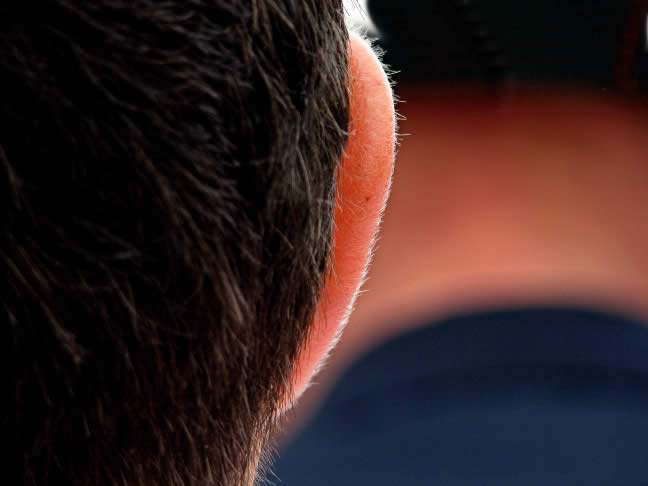
Note: As a college student of music in 1968-9 on the UCLA
campus, I met Dr. Vern Knudsen, then professor of acoustics, for whom
Knudsen Hall is named. We struck up a conversation about music and
perception which led to a friendship and Dr. Knudsen offering me
facility time in the acechoic chamber and a spare room in the physics
building. I conducted several interesting experiments using music
students from my department. One study was to find the limits of
hearing frequency range and how the frequency range is transduced and
sensed by human listeners. I located a hot-rodded Nagra tape deck
modified to run at 30 in/second with 10" reels, and provide -3 dB at 73
kHz upper end frequency response. I also constructed --at great
pain and minor finger injury-- a 60-pound ribbon tweeter using four
Alnico horn magnets from surplus Raytheon magetrons, which measured
flat up to 150 kHz -- the upper frequency limit of the
Brüel&Kjær 4138 lab microphone. The upper-end
frequency hearing perception test consisted of 34 subjects—one at a
time—seated in
the anechoic chamber facing the loudspeaker system with its 60-pound
tweeter from ten feet. Each student was given music stimulus from
the tape while the line-level output to the amplifier was filtered in
steps of 10 kHz from 100 kHz down to a frequency where a 90% consensus
of test subjects identified the high frequency response as being
audibly
affected. That frequency turned out to be 40 kHz or at least
somewhere between the 50 kHz and 40 kHz filter settings. The
filters themselves were hand-wound toroidal inductors and dry Mylar
caps configured in a 24 dB/octave Butterworth filter. The second
phase of the test, conducted purely on speculation on my part as to how
very short wavelengths of sound could penetrate the ear canal all the
way to the tympanum and still have any magnitude, involved fitting the
test subjects with a rubber bathing cap, and applying a thin coating of
Vaseline over the forehead, on the exposed face, and on the outer ears,
and then repeating the tests. We found, quite to our amazement,
that none of the students who had reliably identified a 40 kHz low pass
filter, could identify a 20 kHz filter at all, which suggests if not
proving, that very short airborne sound waves do not effectively
traverse the ear canal, and are principally transduced by facial
cilia. Also worth noting is that all test subjects were
electrically grounded to the anechoic chamber wire cable floor so that
static buildup would not flex facial cilia.
Some of the extra information contained in analog tape recordings or analog direct to disc recordings, specifically, frequencies above the range of typical human hearing and loudspeaker reproduction capabilities, may be useful to the ear brain in the process of hearing music, but extra information that is not part of the original musical sound sources may in fact not be at all useful—it may be only noise, tape hiss, tape over-modulation, record groove or tape modulation distortion or tape head surface scrape, or a host of other non-linearities that really have nothing to do with the recorded music. Extreme low frequencies, below the range of musical instruments but still within the range of human hearing, are almost completely lost in analog tape recording due to the fact that the signal wave lengths are so much longer than the physical width of the tape head itself. This latter limitation is absent in digital recording, which captures frequencies as low as the analog input circuits allow—usually somewhere in the range of one to two hertz. When digital CDs were introduced in 1984, there was much talk about how the “warmth” of analog recordings seemed lost. That same observation is no longer significant today. The reason is simple; we have grown accustomed to the sound of the audio which we have at hand—that which we hear every day. Before 1984, when we knew only the hiss of the tape and the crackle of the LP, it was disconcerting to hear clean, pure audio. We simply were not used to it. Classical music recording engineers of course, were immediately enamored of the clean sound, having heard lots of clean audio through headphones from live microphones, which were never processed or fed through blinking boxes that squeezed, squashed and manipulated the original signals. However, human males have enormous difficulty integrating the experience and knowledge of others—particularly competitors—with their own knowledge, and so the experience and observations of classical music recording engineers was lost on the majority of non classical recording engineers. In actual fact, virtually all of the high end stereophiles (and by that I'm talking about the super tweaks who spend as much as a quarter of a million dollars on a stereo system), who had spent a significant amount of time at concerts listening to live acoustic music, immediately embraced digital recording and then the CD. Only listeners whose primary exposure to music was LP recordings and cassettes were ever among the group who found fault with the sound of CDs. When the first CD re-releases of some popular LPs first appeared, there was a brief time lag before mastering labs figured out that the extensive EQ and processing exceptions made to compensate for the mechanical transfer functions of vinyl records and phono cartridges was not needed for CD mastering, but that abated as quickly as a year after the introduction of the CD to the mass market and has not been an issue since then. 1 Link to Grammy-nominated CD 2 Actual use is the best test. This saying appears in Don Quixote, by Miguel de Cervantes. 3 Auditory neurons excited by the vibration of their corresponding cochlear hair cells, fire “clicks” which are seen on an oscilloscope as simple narrow pulses. These pulses are assembled and decoded by the brain which forms mental impressions of the sounds that originally caused the stimulus. In this sense, the ear's hearing mechanism acts much like a microphone that has a true digital output, and the brain acts as a D-A converter from which the analog “output” is the mental impression of sound. |
HOME
 "
on the remote.
Note: for concert audio, the no-gap
between tracks CD burning means that, too bad, but advance will mute,
so
place track markers around a second before where you want the advanced
track to start playing. Be sure to set all markers to CD
frames to meet Red Book requirements and make CD players happy.
"
on the remote.
Note: for concert audio, the no-gap
between tracks CD burning means that, too bad, but advance will mute,
so
place track markers around a second before where you want the advanced
track to start playing. Be sure to set all markers to CD
frames to meet Red Book requirements and make CD players happy.